Weighting Scheme
Partial properties
In MDANSE, most properties are split by atom-type and the total results is a sum of these partial properties. For example, the partial coherent and incoherent intermediate scattering functions scaled with weight factors are
where \(\alpha\) and \(\beta\) are the atom-types. \(W_{\alpha\beta}\) and \(W_{\alpha}\) are the weights of the atom-type pairs \(\alpha\beta\) and the atom type \(\alpha\). \(c_{\alpha} = N_{\alpha} / N\) and \(c_{\beta} = N_{\beta} / N\) are the concentrations of atoms of atom-types \(\alpha\) and \(\beta\) and \(N_{\alpha}\), \(N_{\beta}\), and \(N\) are the \(\alpha\), \(\beta\), and the total number of atoms. The total is now a sum of the partial terms
Note that for summation involving two atom-types only the unique pairs are summed up. This is because in MDANSE the off-diagonal weight terms are doubled and and we assumed that \(\mathcal{F}_{\text{coh},\alpha\beta} = \mathcal{F}_{\text{coh},\beta\alpha}\).
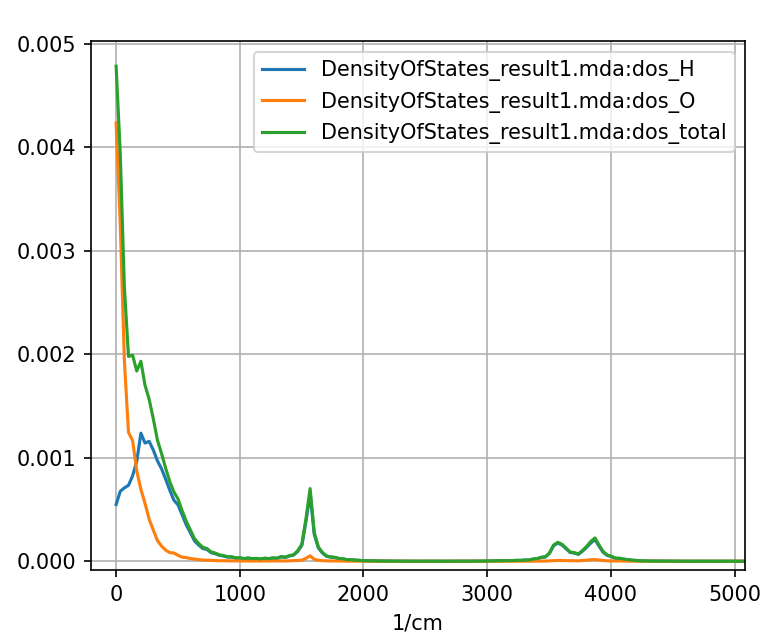
Fig. 1 The total and partial DOS of water, partial DOS are weighted so that the sum of partial DOS equals to the total.
The partial properties can also be scaled without the weights
so the total will now be a weighted sum of these partial terms
In the MDANSE_GUI you have the option to plot either weighted (e.g. \(\mathcal{F}_{\text{coh},\alpha\beta}\) and \(\mathcal{F}_{\text{inc},\alpha}\)) or unweighted (e.g. \(F_{\text{coh},\alpha\beta}\) and \(F_{\text{inc},\alpha}\)) partial properties.
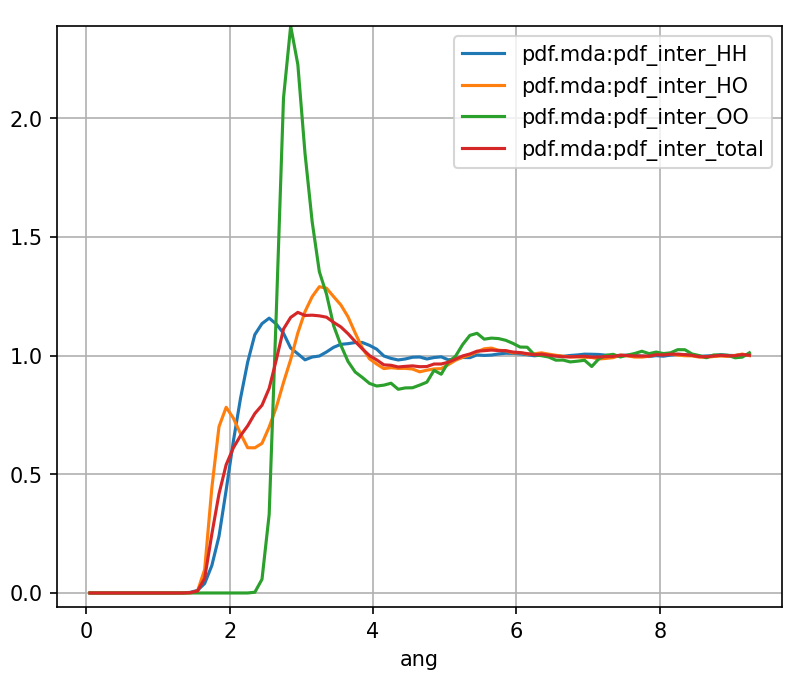
Fig. 2 The total and partial intermolecular PDF of water, partial PDF are unweighted so that the weighted sum of partial PDF equals to the total.
The weighted and unweighted options are more useful for different cases, for example, it might be more useful to use the weighted terms for the density of states (DOS) calculations (Fig. 1) while the unweighted terms might be more useful of the pair distribution function (PDF) calculations (Fig. 2).
Rescaled Weights
Single Atom-Type Weights
MDANSE weights are rescaled so that weights for DISF calculation using the b_incoherent will be
where \(b_{\mathrm{inc},\alpha}^2\) is the squared incoherent scattering length of the atom type \(\alpha\). Note that the weights were squared prior to the rescaling, see Squared Weights for details. By using the rescaled weights the total incoherent intermediate scattering functions becomes
Notice that by using this weight scheme the total DISF has the property that
Double Atom-Type Weights (DCSF and CCF)
For the DCSF calculation using b_coherent, the weights are
where \(b_{\mathrm{coh},\alpha}\) and \(b_{\mathrm{coh},\beta}\) are the coherent scattering lengths of the atoms of types \(\alpha\) and \(\beta\). The total coherent intermediate scattering functions becomes
where \(b_{\mathrm{coh},j}\) and \(b_{\mathrm{coh},k}\) are the coherent scattering lengths of atoms \(j\) and \(k\). Notice that the total intermediate scattering function (sum of the incoherent and coherent parts) will not be equal (or equal to the sum by some scaling factor) to the to the sum of intermediate scattering function from the DISF and DCSF calculations using the scaled weight scheme since they are not scaled in the same way.
Double Atom-Type Weights (Other)
For calculation other than the DCSF and current correlation function (CCF) a slightly different weight scheme must be used as their partials are normalized slightly differently. In MDANSE the partial static structure factor (SSF) is
where
are the partial PDFs. Using b_coherent the weights are
notice that the concentrations \(c_{\alpha}c_{\beta}\) are not square-rooted, this is because the the partial SSF has a prefactor of \(1 / N c_{\alpha}c_{\beta}\) while DCSF and CCF calculations have a prefactor of \(1 / N \sqrt{c_{\alpha}c_{\beta}}\).
Squared Weights
For the DISF, GDISF, EISF, and VHF (self-part) calculations all weights are squared prior
to being rescaled. For the DOS, PACF, VACF, and PPS calculations
the weights are squared prior to being rescaled for only the b_coherent
or b_incoherent weights. In most cases the rescaled weights
with single atom-type weights will be
while in some cases when the weight are squared
where \(w_{\alpha}\) is some weight parameter for the atom-type \(\alpha\).